
How does your work respond to the idea of 'the mundane'?
My work responds to the mundane by reconfiguring everyday objects into structures that feel symbolic, unstable, or ritualistic. I am interested in how repetition, maintenance, and overlooked materials carry emotional and social weight. By shifting ordinary items out of their expected function, I allow the familiar to become strange, revealing the hidden tension embedded within daily life.
How does your work incorporate 'chance'? This can be during its creation, its engagement, interaction, or any other form.
Chance plays a central role in my process through intuitive assembly and recombination. Rather than beginning with a fixed design, I often allow form to emerge from stacking, balancing, and rearranging found elements. The final structure is shaped by material encounters, gravity, instability, and unexpected relationships between objects. In this way, chance becomes both method and collaborator.

‘RABOTA! (PERSIL TOWER)’
MEDIUM: MANIPULATED READYMADE / MIXED MEDIA ASSEMBLAGE
In Maintenance of Meaning, repetition accumulates into sediment. At what point does repetition stop being invisible routine and become form? Is visibility the result of duration or disruption?
Repetition becomes form when it begins to leave a trace - not only on the surface of objects, but within the body and the mind. At first, routine is invisible precisely because it functions. It maintains order without demanding attention. But repetition is never neutral. It accumulates. It gathers weight. It becomes a quiet architecture. For me, visibility emerges through two parallel processes. One is physical: the act itself, repeated again and again - wipe, rinse, stack, return - until time thickens into something almost material, like sediment collecting at the bottom of a river. The other is mental: intention. The decision to look at the act differently, to treat the gesture as something worth holding, shaping, and questioning. It is the consciousness before, during, and after the act that transforms maintenance into art. So the mundane becomes visible not only through duration, but through a subtle disruption - a slight misalignment, a shift in rhythm, a moment when the body hesitates. That hesitation is where meaning begins. It is as if repetition suddenly reveals its hidden tension, and what was once automatic becomes charged. Ultimately, the boundary between routine and form is not defined only by time or accident, but by an inner recognition - a spark, a pressure, a moment of internal illumination that says: this is no longer only function. This is something else. That inner ignition becomes a compass. When it happens, I trust it, and I follow it, like the first domino that falls and sets an entire structure into motion. In Maintenance of Meaning, repetition is not simply a loop. It is a pressure. It is time made physical. What begins as routine gradually becomes a structure - and that structure eventually becomes impossible to ignore.
You describe moments where “a bucket tilts differently” and something shifts. How do you recognise when a small imbalance has crossed into meaning?
I recognise meaning at the moment when the ordinary refuses to remain background. A bucket tilting differently is a small event, almost insignificant, yet it can contain a complete shift in perception. Suddenly the world feels slightly unstable, slightly absurd, or strangely alive. The artist, I believe, must develop something close to a detective’s instinct. Beyond being a maker, thinker, or researcher, the artist must cultivate a heightened sensitivity - a sharpened sense of noticing. I imagine it almost like a detective quietly observing a scene, magnifying glass in hand, attentive to the smallest detail. Nothing dramatic announces itself. The shift is subtle. The role is not to force meaning, but to recognise it when it appears. That recognition can arrive in many forms: a tension in the body, a sudden humor, a quiet unease, an unexpected beauty, a brief suspension of breath. Sometimes it is only a slight internal spark - a feeling that something has moved out of its functional position and entered another space. In that instant, the object is no longer merely practical. It begins to resonate. It feels almost like catching something in the act - a quiet “ah” moment. A small deviation becomes charged. The imbalance is no longer accidental; it reveals a hidden structure. The mundane is full of these thresholds. A minor shift becomes a rupture. And suddenly the object is not just an object – it becomes a witness, a metaphor, or a silent presence. Meaning emerges not because the event is large, but because perception sharpens. The inner awareness responds to the physical moment, and something aligns. What was once unnoticed becomes inevitable.
In Rabota! (Persil Tower), cleaning tools become monumental and oppressive. Do you see maintenance labour as inherently ritualistic, or does it become ritual only through artistic framing?
For me, maintenance labour becomes ritual because it is existentially imposed. It is not something we choose in a poetic sense; it is something life requires. The moment an action repeats from one day to the next, it becomes routine - and routine, at its core, is a form of ritual. Not religious, but structural. It shapes the day. It shapes the body. It shapes time. Cleaning, repairing, sustaining - these gestures are unavoidable. They form the base layer of human existence. Because they must be done, they accumulate weight. Over time, repetition becomes choreography, and choreography becomes a kind of lived ritual. In everyday life, however, maintenance is rarely acknowledged as meaningful. It is reduced to function. Its invisibility becomes part of its burden. In Rabota! (Persil Tower), the tools become monumental not to glorify labour, but to expose that burden. Maintenance becomes oppressive when it is endless, unseen, and required without recognition. Art does not invent ritual. It reveals the structure that was already there. By shifting scale and context, the work allows the viewer to see maintenance not as background, but as a condition of existence – a quiet system that sustains life while simultaneously wearing it down.

You build through stacking, balancing, and rearranging. Is instability something you aim to control, or do you seek a point where the structure feels genuinely precarious?
‘BBQ BICYCLE’
MEDIUM: STEEL, FOUND OBJECTS, MIXED MEDIA SCULPTURE
I’m drawn to the tension between stability and instability. That tension is not merely structural - it is the pulse of the work. I’m not interested in instability as a superficial gesture, but in tension that generates meaning. What interests me is a charged equilibrium - a structure that feels alive because it holds opposing forces at once. The process often begins as an instinct, something almost subconscious - a desire to see a certain kind of tension in space. As I work, that instinct becomes conscious decision-making: I stack, adjust, test, and rearrange, entering into dialogue with gravity, weight, and material resistance. The sculpture must hold. It needs to remain physically stable. Yet at the same time, I trust the structure and allow it to speak back. I give the work space to reveal what it wants to become. If a composition feels too stable, I introduce imbalance. If it becomes too chaotic, I search for anchoring. I remain in constant negotiation between these forces until the work feels complete. I’m not seeking fragility for its own sake, but the creation of a new configuration - a recombination of familiar objects into something strange, compelling, and meaningful. It is within that balanced tension that new interpretation becomes possible. For me, this balance is not only an aesthetic choice. It becomes a way of generating meaning. The instability creates a subtle emotional tremor - something that unsettles the heart even when the structure appears stable. Even when nothing actually falls, an inner tension can emerge, as if something might shift at any moment. And once the work stands before a viewer, the same movement can occur: the object enters perception, touches something beneath language, rises into awareness, and begins to reshape interpretation. In that sense, the structure becomes a trigger - not a fixed message, but a condition that activates thought and feeling, inviting the viewer into their own internal shift.
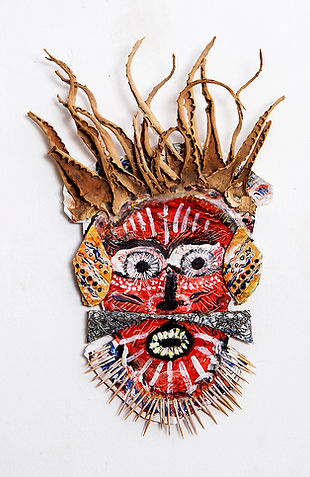
In African Mask – Assemblage, a face emerges from leftovers. Do you believe identity is something assembled through chance encounters, rather than predesigned?
Yes, I do believe identity is assembled. Of course there is a foundation - our DNA, our temperament, the basic inner structure we are born with. But from the moment we enter the world, we are shaped by forces far beyond our control: family, environment, the people we meet, the places we live, and the circumstances we are born into. Identity is not something I experience as a clean design or a fixed plan. It is formed through accumulation - fragments, encounters, pressures, losses, successes, memories, and small moments that remain in the body. In a way, identity is less a portrait than an assemblage: built from what breaks, what survives, and what refuses to disappear. We are not only made from what we choose, but from what chooses us. In African Mask – Assemblage, the face emerges from leftovers because that is how the self often emerges as well: not through a blueprint, but through what remains after experience. Chance plays a central role in that process. We don’t choose many of the elements that shape us - we are exposed to them, we stumble into them, we absorb them. The assemblage becomes a way of showing that identity is both constructed and accidental. The mask is not a disguise, but a presence - a form built from what life provides, from what survives, and from what unexpectedly gathers into meaning.